Showing posts with label Outside Learning. Show all posts

Thursday, December 8, 2011

Great Britain and the Nature of Europe

3 comments
Since 2008, the pound has lagged the euro.
Image credit: Yahoo! Finance
Among the bystanders caught up in the Eurozone crisis is the United Kingdom of Great Britain. As the NY Times correctly notes, the UK is stuck between a rock and a hard place.

While the Brits are a party to the European Union, they are not a member of the Eurozone--they kept the British pound instead of transitioning to the euro note. As such, their monetary security should not be immediately affected by a collapse of the European currency. The British pat themselves on the back for this decision, especially (but not limited to) PM David Cameron and his ruling Conservative Party. But should they be so self-satisfied?

In a previous era, staying on the pound would have guaranteed a buffer against continental woes. But Britain's membership in the European Common Market--and the simple matter of their geographically-defined exposure to the European economy--guarantees that the UK would be hit hard by the disruption in trade and finance that would likely follow the euro's implosion.

Moreover, one need only glance at the performance of three major currencies since 2008 to take a bit of polish off of the pound sterling: Britain's independent currency has underperformed both the US$ and the euro since the onset of the financial crisis (see top right).
Sunday, December 4, 2011

Whither collapse and recovery?

2 comments
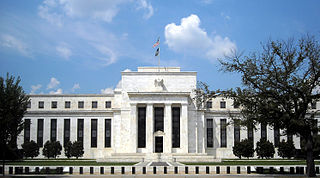
Federal Reserve Board Building
Photo credit: Wikipedia
Mark and Mauricio recently sent me a pair of articles that relate to what we've discussed in class this semester.

In the first article, Paul Krugman (Nobel-winning economist) and Larry Summers (former adviser to President Obama) debate whether the US is facing a "lost decade," or a long period of slow growth that doesn't quite count as a recession. Mr. Krugman believes we are, while Summers disagrees. I happen to agree with Summers. What do you think?

In the second piece, Bloomberg reveals that the Federal Reserve (the US central bank) lent out $7.7 trillion (with a 't') to beleaguered banks during the 2008 financial crisis. This is something that we're just learning about now, and it dwarfs the $770 billion Troubled Asset Relief Program (TARP) that became the focal point of the government's stimulus program.

Should the Fed have disclosed these loans earlier? Or should it have protected these banks from the stigma of failure that may have precipitated a run?

Monday, November 28, 2011

Euro Crisis Continues

1 comments
One Euro Piece
Photo credit: Wikipedia
Just before the Thanksgiving holiday, the European currency crisis claimed its fifth government victim: Spain's Socialist government, which had ruled since just after the 11 March 2004 rail bombings in Madrid, lost in parliamentary elections. But parliamentary transitions won't solve the underlying problems that the crisis is only now unearthing.

If you're going to link several governments to a single currency, the currency zone must A) restrict member state borrowing or B) constantly bail out poorer states when things turn sour. So far, the EU and the Euro-trading states have been unwilling to agree to either.

Despite widespread acknowledgement of the disaster that might result from the collapse of the Euro, there is still a chance that the system may fold or fracture. France and Germany are pushing the debtor states to reign in their spending and place caps on future borrowing, but they cannot do so without approval of the states themselves (and if they didn't want to curtail borrowing before, they may be less likely to now that they have to find money to service prior debts).

What happens if the Euro dissolves or merely shrinks? Think widespread bank defaults and capital evaporation on a greater scale than what we experienced in 2008. This is not what we in the US needs just as several leading indicators of domestic growth are turning positive. Whether Europe gets its act together will affect us all directly, from the cost of the products we buy to the likelihood that we get jobs upon graduation.

Such is the reality of the globalized, integrated market economy.

Friday, November 18, 2011

Democracy over Time (Updated with Atlas)

0 comments
Democracies (states that score above 5 on the Polity IV scale) compose the majority of states today, and democratic state pairs (dyads) are more common than autocratic dyads or mixed dyads. It wasn't always this way. Use the slider at the bottom of the graph below to explore how the distribution of democracies and dictatorships has evolved over time.

Monday, November 14, 2011

Worst Harvest in 30 Years Spikes Peanut Butter Prices

0 comments
Peanut Leaves and Pods
Photo credit: Wikipedia

Stacey mentioned in class that the price of peanut butter has skyrocketed following the worst peanut harvest in 30 years. According to this article by the Wall Street Journal (via the Pocono Record):
Another hot, dry summer has devastated this year's peanut crop, sending prices for the legume skyrocketing and forcing peanut butter brands including J.M. Smucker Co.'s Jif, Unilever NV's Skippy and ConAgra Foods Inc.'s Peter Pan into startling price increases...
Weather is the ultimate nemesis of any farmer. That's why the cotton farmers in Travels of a T-Shirt use technologies to protect cotton from, and to "control," the weather. It's also one of the reasons why the US government subsidizes farmers--to prevent bad years from sinking farmers so that they can profit from the good ones. According to Huffington Post, peanut butter's not the only product that's increasing in price owing to a poor harvest.
French wine and Italian pasta are some other endangered national exports impacted by climate change. Last week, a report claimed chocolate could become a luxury item if farmers in West Africa didn't adapt to the warming climate.
Even with a bumper crop, however, the price of peanuts will likely climb regardless. As the government continues to subsidize cotton and corn, farmers will devote more acreage to those crops and less to others, including peanuts. This will decrease the supply--and increase the price--of peanuts.

Peanuts are an important part of the American agricultural economy. They put nitrogen back into the soil, as opposed to most crops that deplete nitrogen. Peanuts allow planters to rotate crops to maintain soil integrity, use fewer artificial fertilizers, and yet still produce a crop that can earn them some money on the market.

Wednesday, November 9, 2011

"Greek Flu" Hits Italy

0 comments
Italian PM Berlusconi (right)
Photo credit: Wikipedia
Here are the links to the videos I showed in class today regarding the Italian debt crisis, which is of course linked to the larger Eurozone Crisis:
So far, the markets seem pessimistic about Italy's capacity to roll over the ~$500 billion in debt that comes due next year. The Dow 30 is down pretty much across the board.

Tuesday, November 8, 2011

Primer on the Eurozone Crisis

0 comments
Flag of the European Union
Image credit: Wikipedia
For those of you who are curious about what's going on with the European Debt Crisis, here are some links that you might find useful.

Moreover, the links on the left hand side point to other blogs and news sources that have been reporting on the issue. The news items on the left hand side provide up to date news: you can hone in on the appropriate topic by clicking the "Europe" or "Greece" links.

In related news, the crisis has claimed yet another head of state. Earlier today, Italian Prime Minister Silvio Berlusconi resigned, clearing the way for Italy to restructure its spending and debt.

What do you think? Are we out of the woods yet?

Sunday, November 6, 2011

Joseph Stiglitz Expresses the Keynesian View Re: Greece

2 comments
(Former) Greek PM Papandreou
In this op-ed for BBC Online, economist Joseph Stiglitz finds several faults with the current situation in Europe, ranging from the construction of Euro institutions to the Greek bailout plan.
One of the things that makes the American common currency work across the country is we have a common fiscal authority and high migration... In Europe, there's no fiscal authority, migration is more difficult and most of the countries are not willing to let themselves become empty.
One of the reasons why the European Union is not quite a "United States of Europe" is due to a lack of centralized monetary policy and labor mobility. This can lead to differences in interest and agreement that might weaken the Euro. This is one of the reasons why Europe has been so slow in dealing with the Greek crisis.
Over the longer term they're going to need European bonds and a number of other actions, and they have to recognise the framework of austerity is not the way to go.
Now, this is interesting. Stiglitz is challenging the view of Greece's creditors that austerity--in other words, massive budget and public sector cuts--is the solution. Stiglitz felt the same way when it came to the Asian Financial crises, but his warnings were not heeded.

Why might Stiglitz buck the orthodox view, here? What might be the dangers of forcing Greece to radically scale back its public sector, including its very cushy welfare state?

Thursday, October 27, 2011

The (Political) Economy of Ale in DC

0 comments
Juan passed along this article which speaks directly to what we watched in Beer Wars. The well-traveled among you may have noticed that beer prices are higher in DC than just about anywhere else in the country (except, perhaps San Francisco and/or New York). This article tries to explain why.
The biggest markup on that cold one in your hand generally takes place at the retail level—the bars, restaurants, shops and supermarkets that sell beer directly to consumers. Here’s where D.C. propels local beer prices into the stratosphere... the tavern owner figures you can afford it. “The recession never really hit D.C.,” says Brian Kruglak, beer director at Jack Rose Dining Saloon..."
In other words, part of the answer is boring old supply and demand. DC has more well-off young people than almost anywhere else in the nation. That means there's high demand for all products here that appeal to young demographics, including beer. Beer is expensive in the DC metro for the same reason housing prices are so high.

But politics aren't completely absent from the equation.
The District’s neighborhood politics—which make it very easy for local residents to get in the way of liquor licenses, adding new costs for retailers—also pushes prices above where they’d be elsewhere... Most retailers I spoke with point to a standard mark-up of 40 percent on beer. But sometimes even that substantial margin doesn’t begin to cover the high rent and overhead... Add to that 40 percent figure a 10 percent sales tax on alcohol in the District, and us brewhounds are paying nearly 50 percent over wholesale prices for each six pack.
Beer is only the most obvious example, but this occurs with all sorts of products you buy. Very rarely is the answer just economics or politics; it's almost always both.

Wednesday, October 26, 2011

Ownership of Beer Brands and Varieties

0 comments
Professor Phillip Howard at Michigan State University designed a fantastic infographic illustrating consolidation in the beer industry.

Who owns your (assuming you are of drinking age) favorite brand? Double click on the image below to zoom in and explore.
 

Wednesday, October 19, 2011

Wapshott on Keynes, Obama and Jobs

2 comments
I found this editorial when searching for a picture of John Maynard Keynes for my slides on Monday. It connects a topic we've been discussing--Keynesian macroeconomics--to a modern day issue: will the president be re-elected? Mr. Wapshott offers:
No president since 1948 has been elected with a jobless figure higher than 7.2 per cent, so with unemployment currently running at 9.1 per cent, he looks headed for certain defeat... With the White House admitting there is little chance unemployment will fall before the election next year, the president needs some good advice on how to get people back to work, and fast.
Fan or not of President Obama, things aren't looking that good for his chances next November. Keynes would say that the stimulus was a good start, but...
...the trillion dollar injection into the economy was far too small to do much good and in many cases went to the wrong people and was spent on the wrong projects... Keynes’s famous “multiplier,” by which every dollar spent is worth far more as it is passed from hand to hand, doesn’t work if the cash is placed under a mattress.
The article is a good read, whether or not you agree with Keynes, Obama or government stimulus. It helps clarify the issues that we've been discussing in class, plus reveals that Keynesian economics isn't a partisan issue. For instance, Keynes favored lowering taxes during recessions, a plan that Republicans have supported wholeheartedly.

Friday, October 14, 2011

Have We Hit Rock Bottom?

0 comments
This article at WaPo argues that another recession is unlikely because there's simply no room left for the American economy to fall:
But auto sales have rebounded to only about 13 million a year, meaning that there is not as much room to fall if waning consumer confidence again leads Americans to become ultra-cautious.


This theory makes sense so long as we don't suffer a strong external shock, such as a terrorist attack, an oil shortage or--perhaps more immediately--a sovereign default in Europe.

According to classical economic theory, this is exactly how recessions are supposed to work: 1) economic transactions purge unprofitable concerns from the economy; 2) eventually production and prices stabilize at more sustainable levels; 3) pessimism abates; 4) growth resumes; 5) employment rises.

On the other hand, the Keynesian would argue that these corrections can be so painful as to be disastrous, that they're unnecessary, and that, while this should work out in the long run, "...in the long run we're all dead."

What do you think?

Tuesday, October 4, 2011

Al Jazeera: China warns against US currency bill

0 comments
Belen forwarded along this news item that gets right at what we've been talking about in class:
China's foreign ministry has said it "firmly opposes" a bill pushed by the US Senate that will allow the country to impose duties on countries that undervalue their currencies. In a statement posted on China's official government website on Tuesday, the ministry said the US was "using the excuse of 'currency imbalances'" to adopt protectionist trade measures that violated World Trade Organisation rules… The Senate voted on Monday to advance legislation designed to press China to let its currency, yuan, rise in value.
Think about why China might be so concerned about keeping their currency cheap, and why the United States (or certain constituencies within the US) would have an interest in making the Chinese currency more expensive.

Finally, is this a good idea? Why or why not?

Monday, September 26, 2011

A Libertarian Case for Government Protection of the Environment

1 comments
A great post at Bleeding Heart Libertarians makes the case that libertarians—who are typically vehemently opposed to government intervention in market transactions—should favor government-regulated environmental protections. I'll let the author, Jason Brennan, do the heavy lifting:
  1. Pollution and other kinds of environmental externalities impose costs upon others… [a violation of] people’s property rights…
  2. Government regulation of environmental issues is USUALLY/OFTEN/SOMETIMES effective, and is USUALLY/OFTEN/SOMETIMES more effective than using courts to defend the rights mentioned in premise 1…
  3. Therefore, government should have the right to issue environmental regulations in order to protect property rights, rights to life, and rights to health.
It's a loaded claim, that environmental regulation is on the same level as protecting private property in terms of the government's responsibility to its citizens.

Do you agree or disagree with the premises listed above? Share your thoughts on this topic if you have some.

Thursday, September 15, 2011

"Maybe you coulda done this whole 'hit 'em where it hurts' thing before America slid into an unstoppable sh*t spiral."

0 comments
From Jon Stewart:


As usual, Mr. Stewart's firing on all eight cylinders. There's a lot going on in this clip: both sides are taking heat; criticism of the apparent sublimation of the president's "Hope and Change" candidacy; easy jokes about the facial expressions of old white (and sometimes orange) men; and of course a little bit about politics and economics.

Possible points of discussion:
  • What can the state (and, specifically, the presidency) do to grow the economy?
  • What should the state do during a recession?
  • How might the interests of those in the White House and Congress affect how they vote on economic policy legislation?
  • In what way might House and Senate Republicans take issue with the American Jobs Act?

Sunday, September 11, 2011

The Costs of September 11th

4 comments
While we can't measure the value of the 3,000 lives lost on September 11th, 2001, we can measure the economic toll the country has paid—and continues to pay—since that fateful Tuesday morning. MarketWatch has a thoughtful take:
A recent study by Brown University pegs the total costs of post-Sept. 11 actions by the U.S. at $3.2 trillion to $4 trillion — and counting… Care of veterans, for example, could add up to an additional $1 trillion over the next 40 years, the study estimated. And interest payments on the national debt could take decades to pay off.
War is expensive—a fact we'll touch on a few times this semester. Is there a price that's too high to pay to keep America safe?

Monday, August 22, 2011

Gold May Not Be As Safe As You Think

0 comments
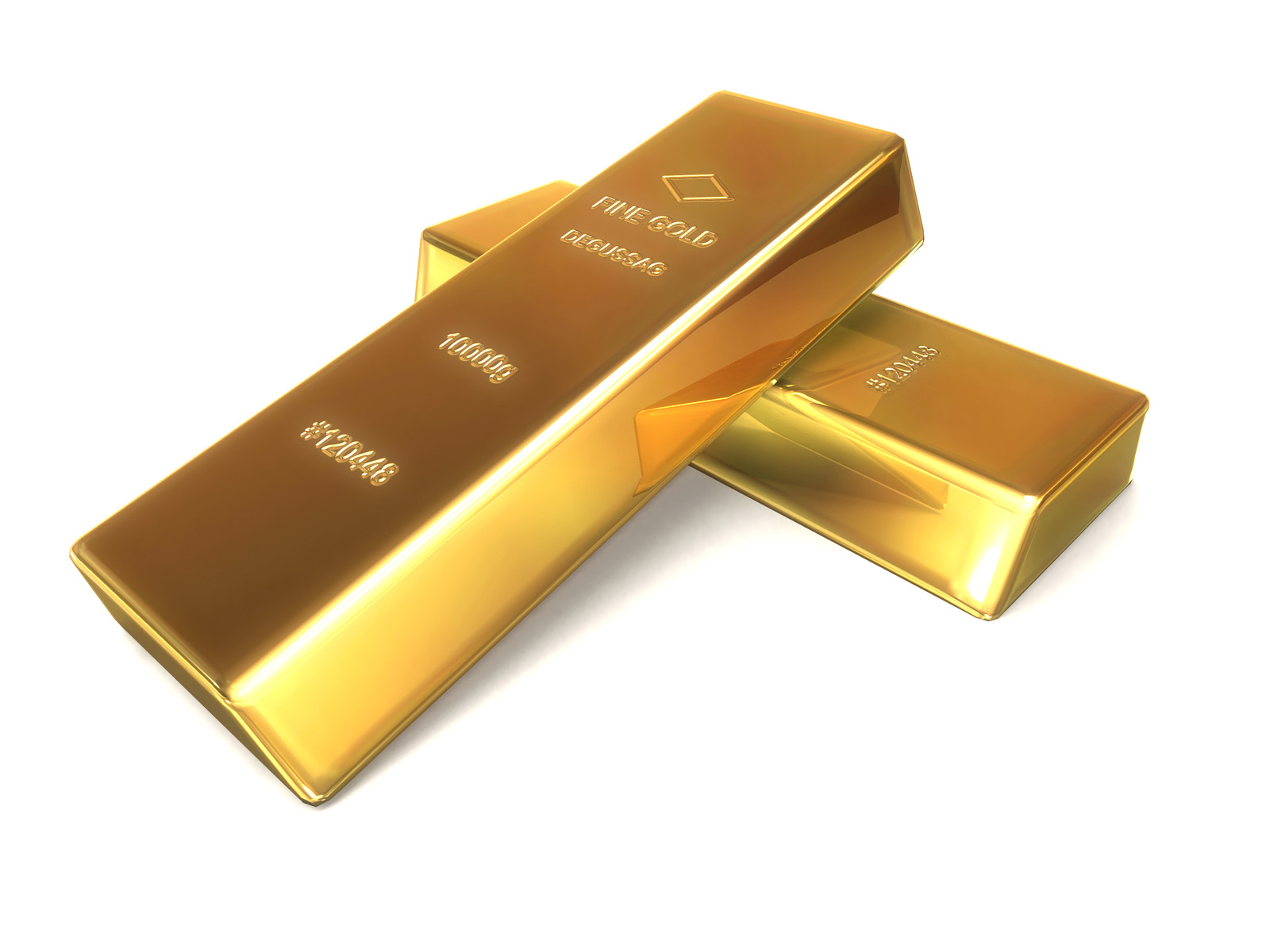
Economists suggest gold investments are risky
"In the long run, gold has gone up," Thomas said. "But in 2000 the price of gold was $300 an ounce. It has gone up six-fold since then, and it might go up higher than what it is right now. It's gone up too fast -- it's a bubble."
--PhysOrg.com

Sunday, August 14, 2011

Five Myths about the Dow Jones Industrial Average

3 comments
Is the Dow 30 still just a collection of American industrial corporations? Is it a reasonable estimate of the health of the broader economy? James K. Glassman has the answers.
"Even stranger is how the Dow is calculated. Most indexes, including the Standard & Poor’s 500, are weighted by market cap: Bigger companies affect the index’s value more than smaller ones. But the Dow is weighted by stock price — an arbitrary figure that has little to do with size or value."
--Glassman, Five Myths about the Dow (Washington Post)
See also:

Thursday, August 4, 2011

The Big Mac Index

1 comments
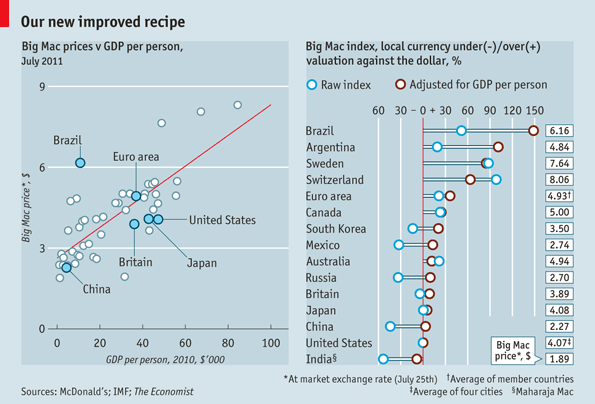
As presented by FlowingData, the Economist's Big Mac Index is an easy to understand measure of inflation and purchasing power in different countries. Simply, it measures how much a Big Mac cheeseburger costs in each of these economies, presented as both a raw number and also adjusted for local incomes.


Question: Why is the Big Mac so cheap in India?